A Country at War With Itself — And Running Out of Safe Ground
Myanmar’s crisis is no longer just a story of a coup and resistance. It is now a toxic mix of
intensifying conflict, record landmine casualties, a booming opium economy, and a tightly managed “election” process that critics say is designed to cement military rule, not end it.
Over the past week and months, three threads have stood out:
- brutal
airstrikes and landmines killing civilians in contested regions
- a sharp
surge in opium poppy cultivation as the legal economy collapses
- the junta’s push for
controversial elections, including early overseas voting, amid ongoing war
Together, they paint a picture of a country sliding deeper into a protracted, militarized crisis with serious regional spillover.
Airstrikes in Sagaing: War From the Sky
The front line has moved into people’s living rooms. In central Myanmar’s
Sagaing Region, the military has stepped up air operations against anti-junta forces — and civilians are paying the price.
On Friday, military jets dropped
two bombs on Tabayin (Dabayin) Township in Sagaing, one striking a busy teashop packed with people watching a boxing match on TV.
-
18 people were killed and about
20 injured, according to a local official, a rescue worker, and residents.
- Around
a dozen nearby houses were destroyed, with witnesses describing the area as “completely devastated.”
Local media aligned with the pro-democracy movement report similar attacks elsewhere in Sagaing:
- an airstrike on
Marakan village in Dibeyin Township
- ongoing clashes and shelling in
Yinmabin Township
Since the 2021 coup, the Myanmar military has increasingly relied on
air power to hit areas it cannot easily control on the ground, particularly in Sagaing and other resistance strongholds. Civilian spaces — schools, markets, village centers, and now teashops — have repeatedly become targets or collateral damage.
Myanmar Now Leads the World in Landmine Casualties
As bombs fall from the air, the ground itself has become lethally unsafe.
Myanmar has recorded the highest number of landmine casualties in the world for the second consecutive year, according to data cited by the International Campaign to Ban Landmines.
Key numbers are stark:
-
2,029 landmine casualties were recorded in the latest reporting year —
double the previous year’s toll.
- That figure is
the highest globally, ahead of Syria (1,015), Afghanistan (624), and Ukraine (293).
Rights monitors say the military continues to:
-
Lay new antipersonnel mines every year, a pattern documented since at least 1999
-
Force civilians to work as “guides” in mined areas, effectively using them to trigger mines ahead of troops
- Coerce people into
forced labor for mine clearance, sending them into high-risk zones
At the start of 2025, casualties spiked near the
Bangladesh border, as displaced people tried to return home through terrain seeded with explosives. This is particularly alarming for
Rohingya and other communities moving back through former conflict areas.
The combination of airstrikes and landmines means that for many civilians,
there is no safe direction to run: danger comes from above, below, and all around.
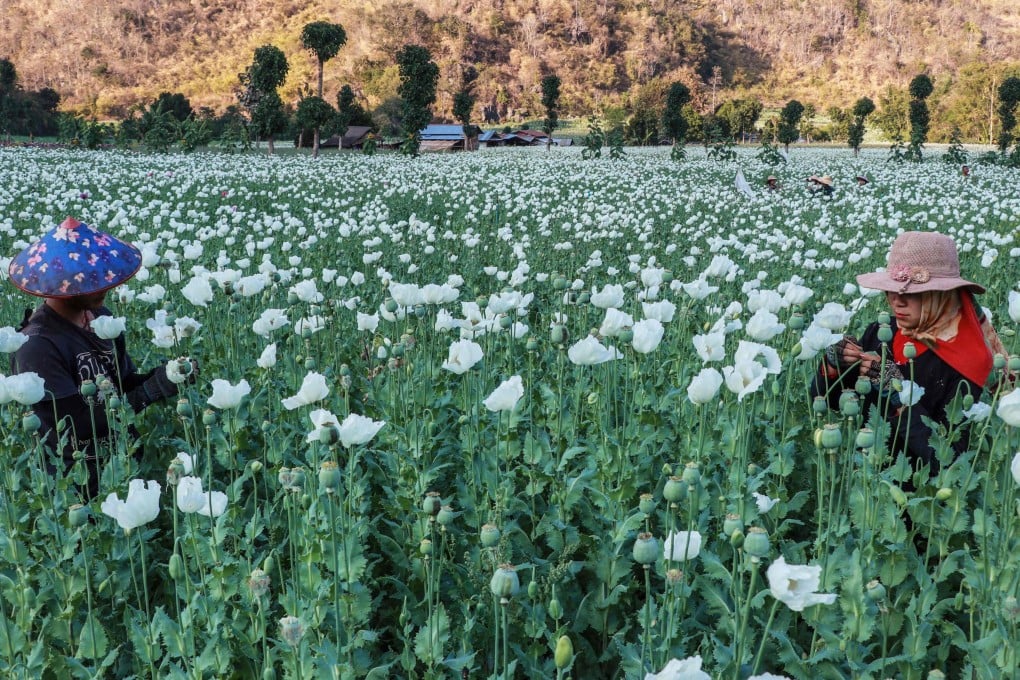
Opium Fields Surge as the Legal Economy Craters
While fighting rages, another map is quietly expanding:
opium poppy fields.
According to the
Myanmar Opium Survey 2025, released by the UN Office on Drugs and Crime (UNODC),
opium cultivation has surged to a 10‑year high.
- Poppy cultivation rose
17% in a single year, from 45,200 hectares in 2024 to
53,100 hectares in 2025.
- Total opium production is estimated at around
1,010 metric tons in 2025 —
more than double Afghanistan’s current output after the Taliban’s opium ban.
Conflict and economic collapse are driving farmers into the drug economy:
-
East Shan State saw a
32% increase in cultivation;
Chin State rose
26%.
-
South Shan State remains the core production hub, accounting for
44% of all poppy fields.
- For the first time, significant cultivation has been documented in
Sagaing Region, long a conflict epicenter, with 552 hectares planted.
Opium has become what UNODC calls a
“survival crop”:
- Farmgate prices for dry opium averaged about
$365/kg in 2025, more than
double 2019 levels.
- Farmers are estimated to have earned
$300–487 million from opium sales in the past year.
Yet even as cultivation expands, yields have fallen in some areas like
North Shan and Kachin, where intensified fighting, fertilizer shortages, and poor soil management are eroding productivity.
With
Afghanistan’s opium output collapsing under the Taliban ban, Myanmar has effectively become
the world’s main source of illicit opium — and with it, a growing supplier of heroin to markets far beyond Southeast Asia.
European authorities have already reported
heroin seizures in 2024–2025 believed to originate from Myanmar, carried by airline passengers traveling via Thailand to Europe. Myanmar is also still a key hub for
synthetic drugs like methamphetamine and ketamine, further destabilizing regional drug markets.
A Controversial Election Push — Starting in Bangkok
Amid war, mines, and opium, the junta is pushing ahead with what it claims will be a path back to democracy:
phased elections. Critics, however, are calling it a
carefully staged performance.
At the Myanmar embassy in
Bangkok, a few dozen people turned up for
early overseas voting in the upcoming polls.
- Polling has also opened early at embassies in
Hong Kong, Singapore, and Chiang Mai, with domestic voting in some parts of Myanmar scheduled to start in late December.
- There are an estimated
500,000 documented Myanmar nationals in Bangkok alone, and about
4.1 million Myanmar citizens living in Thailand in total, many undocumented and displaced by war.
Despite those numbers, AFP reporters saw only around
25 people register in the first two hours at the Bangkok embassy, under a heavy police presence.
Opposition lawmakers, human rights monitors, and armed resistance groups have
dismissed the vote as a sham, arguing that:
- Most genuine opposition and many deposed lawmakers are
excluded from running.
- New laws threaten
up to 10 years in prison for protesting or criticizing the election.
- Large swaths of the country are under active conflict, making any notion of free and fair voting unrealistic.
To many of Myanmar’s exiles and internal opponents, the election is less about public choice and more about
providing a veneer of legitimacy for entrenched military rule.
International Scrutiny and a Slow-Burning Response
Internationally, concern is growing, but coordinated pressure remains uneven.
The
UN Special Rapporteur on the situation of human rights in Myanmar, Tom Andrews, has announced a
visit to the United Kingdom to meet officials, lawmakers, and Myanmar diaspora communities there.
- His mandate is to document abuses, push for stronger international action, and keep Myanmar on the diplomatic agenda.
Yet even as UN experts warn that
“what happens in Myanmar will shape drug markets in the region and far beyond” and rights groups highlight record landmine casualties, concrete action — such as unified sanctions, arms embargoes, or stronger support for refugees — remains fragmented.
Meanwhile, the junta continues to present a parallel narrative. State media highlight
rice exports to Bangladesh, infrastructure projects, and official visits, portraying a country “returning to normal.” For people on the ground in Sagaing, Shan, Chin, and Rakhine, reality looks very different.
Why This Matters Far Beyond Myanmar’s Borders
Myanmar’s crisis is not contained within its frontiers. It is reshaping:
-
Regional security: more refugees, more weapons flows, and a persistent multi-front civil war.
-
Global drug markets: with Myanmar now the
leading illicit opium producer, heroin routes are shifting from Afghanistan to Southeast Asia and beyond.
-
Humanitarian risk: record landmine casualties and intensifying airstrikes are creating zones that will be dangerous for decades, even after the guns fall silent.
For now, the trajectory is clear:
-
Conflict is intensifying, especially in central and border regions.
- **Civilian
Sources
1. Myanmar: Opium crop hits 10-year high amid conflict and economic ...
2. Myanmar - World's largest number of landmine casualties ...
3. Myanmar jets kill 18 in air strike - Newspaper - DAWN.COM
4. Myanmar citizens head to early polls in Bangkok
5. Two Bombs Dropped on a Township in Sagaing Region, 7 Killed
6. UN expert on Myanmar to visit the United Kingdom | OHCHR
7. Spring Revolution Daily News for 7 December 2025 - mizzima.com
8. 7 December 2025 - Global New Light Of Myanmar