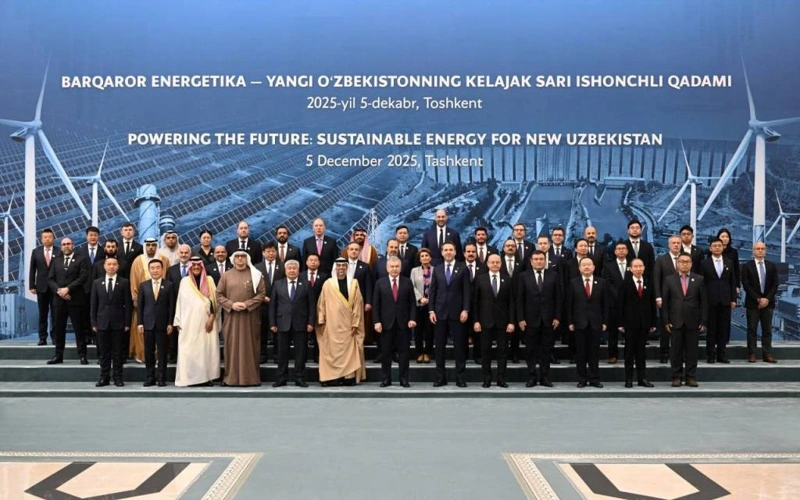
Uzbekistan is betting big that its future will be powered by the sun, wind, and a whole lot of foreign capital—and the numbers it just unveiled are eye‑popping.
The country has launched a massive new wave of clean energy and infrastructure projects worth around €9.46–11 billion, with officials insisting that as soon as next year, the entire population’s electricity needs could be met with green power alone.
This isn’t just another climate pledge. It’s a full‑blown economic and geopolitical pivot.
A New Energy Era: 42 Projects, Billions in Investment
At a high‑profile forum titled
“Powering the Future: Sustainable Energy for New Uzbekistan”, President
Shavkat Mirziyoyev personally launched
42 new energy and grid projects—plus broke ground on
21 more.
According to official and media reports, the package includes:
-
16 new power plants (solar, wind, thermal, and hydro) with a combined capacity of
3,500 MW in regions including Karakalpakstan, Bukhara, Kashkadarya, and Tashkent.
-
10 large‑scale energy storage systems with
1,245 MW of capacity, enabling an extra
1.5 billion kWh to be injected into the grid during peak hours.
-
11 new substations and
420 km of new high‑voltage transmission lines to stabilize the national grid.
Total price tag: about
$11 billion (≈€9.46 billion), much of it coming from foreign investors and international financial institutions.
Mirziyoyev framed it as a historic moment, calling the projects
“another practical step toward Uzbekistan’s sustainable development” and a foundation for a
“modern, next‑generation energy system.”Lights On With Clean Power by 2026?
Here’s the headline claim that grabbed global attention:
Uzbek authorities say that by
2026,
every household in the country could turn on the lights using only clean electricity.
How?
- Once fully operational, the new facilities are expected to generate
15 billion kWh of electricity annually.
- Next year, total
green energy output is projected to hit 23 billion kWh, which officials say will
fully cover the population’s annual electricity consumption.
That doesn’t mean the whole economy will be
100% green—industry will still rely partly on gas and other sources—but on paper,
residential needs could be met entirely by renewables.
Uzbekistan’s
electricity production has already climbed from 60 billion kWh in 2017 to 85 billion kWh this year, driven by new capacity and massive foreign investment.
The Climate Math: Gas Savings and Emissions Cuts
For a country still heavily dependent on natural gas, the environmental—and economic—stakes are high.
The Ministry of Energy says the new wave of renewables will:
- Save nearly
7 billion cubic meters of natural gas- Prevent about
11 million tons of harmful emissions from entering the atmosphere
Those savings are not just climate wins. In a gas‑exporting region,
every cubic meter not burned at home can be sold abroad or redirected to other sectors, boosting state revenue and energy security.
The 2030 Vision: 17,000 MW of Renewables and a 54% Green Grid
Mirziyoyev has set out a striking medium‑term roadmap.
By
2030, Uzbekistan plans to:
- Add
over 17,000 MW of renewable energy capacity- Raise the
share of green energy in total electricity generation to
54%- Build
6,000 km of high‑voltage lines, including
1,000 km next year aloneTo support this, the government says
$35 billion in foreign investment has already flowed into the energy sector in recent years, enabling
9,000 MW of new capacity, and it now wants to attract
more than $150 billion over the next five years for 1,000 industrial and infrastructure projects.
In other words: this is as much about
industrial policy and jobs as it is about decarbonization.
Foreign Players: ACWA Power and Data Center Ambitions
This green surge is deeply intertwined with foreign capital and technology.
- Saudi company
ACWA Power has emerged as a flagship partner in Uzbekistan’s clean energy build‑out, including several of the new wind and solar projects highlighted at the ceremony.
- A Saudi firm,
DataVolt, has begun building a
500‑MW data center worth $3 billion, which will rely on the upgraded grid and help position Uzbekistan as a regional
digital and cloud hub.
Two new industrial enterprises were also spotlighted:
-
Angren Energo – a plant to produce around
15,000 transformers a year
-
Uzhydropower – a facility capable of manufacturing
155 hydro units annually
Together, they are intended to
localize key equipment production, cut imports, and turn Uzbekistan into a
regional supplier for energy technologies.
Nuclear on the Horizon: A Hybrid Future
Even as it turbocharges renewables, Uzbekistan is quietly moving ahead with a
controversial but strategic nuclear plan.
According to World Nuclear News, excavation began in October for the country’s
first nuclear power plant, which will be one of the world’s first sites to combine:
-
Two large Russian VVER‑1000 reactors (1 GW each)
-
Two small modular reactors (SMRs) of the
RITM‑200N type (55 MW each)
The project—developed with Russia’s Rosatom—marks a shift toward a
hybrid energy mix: renewables for flexibility and nuclear for long‑term baseload power.
For a state chasing industrial growth and data centers, that kind of steady generation is politically attractive, even as it raises familiar questions about
safety, cost, and dependency on Moscow.
Beyond Energy: Chemical Industry and Export Push
The green energy drive is also being paired with a broader industrial strategy.
On December 3, Mirziyoyev reviewed proposals to
expand the chemical sector, with aims to:
-
Double the size of the chemical industry by 2030- Increase mineral fertilizer production by
1.5 times- Boost annual
chemical exports to $1 billionRight now,
21 major projects worth $1 billion are underway, with
another $4.5 billion in investment planned over the next three years.
More cheap, stable power—especially from renewables and future nuclear—will be critical to keeping those factories running and exports competitive.
Regional and Global Angle: From Kambarata to the Green Energy Corridor
Tashkent isn’t just thinking within its borders.
Uzbekistan is stepping up
regional cooperation on big‑ticket infrastructure:
- It plans to start
co‑financing the Kambarata‑1 hydropower project with
Kyrgyzstan and Kazakhstan next year, a major hydropower dam meant to stabilize Central Asia’s shared water‑energy system.
- It is also working on the
Green Energy Corridor alongside
Azerbaijan and Kazakhstan, designed to
export Central Asian electricity—especially green power—to Europe.
If even part of this vision materializes, Uzbekistan could transform from a
domestic energy bottleneck into a
regional power exporter.
Domestic Challenges: Drugs, Governance, and Credibility
Amid all the grand energy announcements, there are reminders that Uzbekistan is still wrestling with deep social and governance issues.
A recent analysis from the Foreign Policy Research Institute highlights that
Central Asia’s drug problem is worsening, with Uzbekistan both a transit route and a growing consumer market. In early November, Mirziyoyev approved a
2025–2026 national program to combat drug‑related crime, underscoring pressure on the state to deliver not just growth but
security and social stability.
Meanwhile, local media reported that the journal
Nature retracted a high‑profile climate study after
major data errors related to Uzbekistan were uncovered—a reminder that
trustworthy data and transparency are now central to both climate policy and international credibility.
These undercurrents matter: foreign investors look not just at megawatts and megaprojects, but at
rule of law, institutional reliability, and social risks.
What This All Means for Uzbekistan’s Future
Taken together, Uzbekistan’s latest moves signal a few big shifts:
-
From gas‑dependent to diversified: Renewables plus nuclear could, if delivered, reduce the country’s vulnerability to gas shortages and price swings, while freeing more gas for export.
-
From energy importer to potential exporter: With projects like Kambarata‑1 and the Green Energy Corridor, Tashkent is clearly eyeing a role as a
regional power hub.
- **From low
Sources
1. Uzbekistan unveils new energy capacities and infrastructure projects
2. Uzbekistan Commissions $11 Billion in New Energy Infrastructure ...
3. Uzbekistan launches €9.46 billion green energy push, covering ...
4. Uzbekistan Plans Chemical Sector Expansion as Cotton Output ...
5. Uzbekistan progressing work on first nuclear power plant
6. Central Asia Has a Drug Problem, and It Is Growing Worse
7. Video. Uzbekistan launches €9.46 billion clean-energy projects to ...
8. News of Uzbekistan and the World
9. Address by the President of Uzbekistan Shavkat Mirziyoyev at the ...