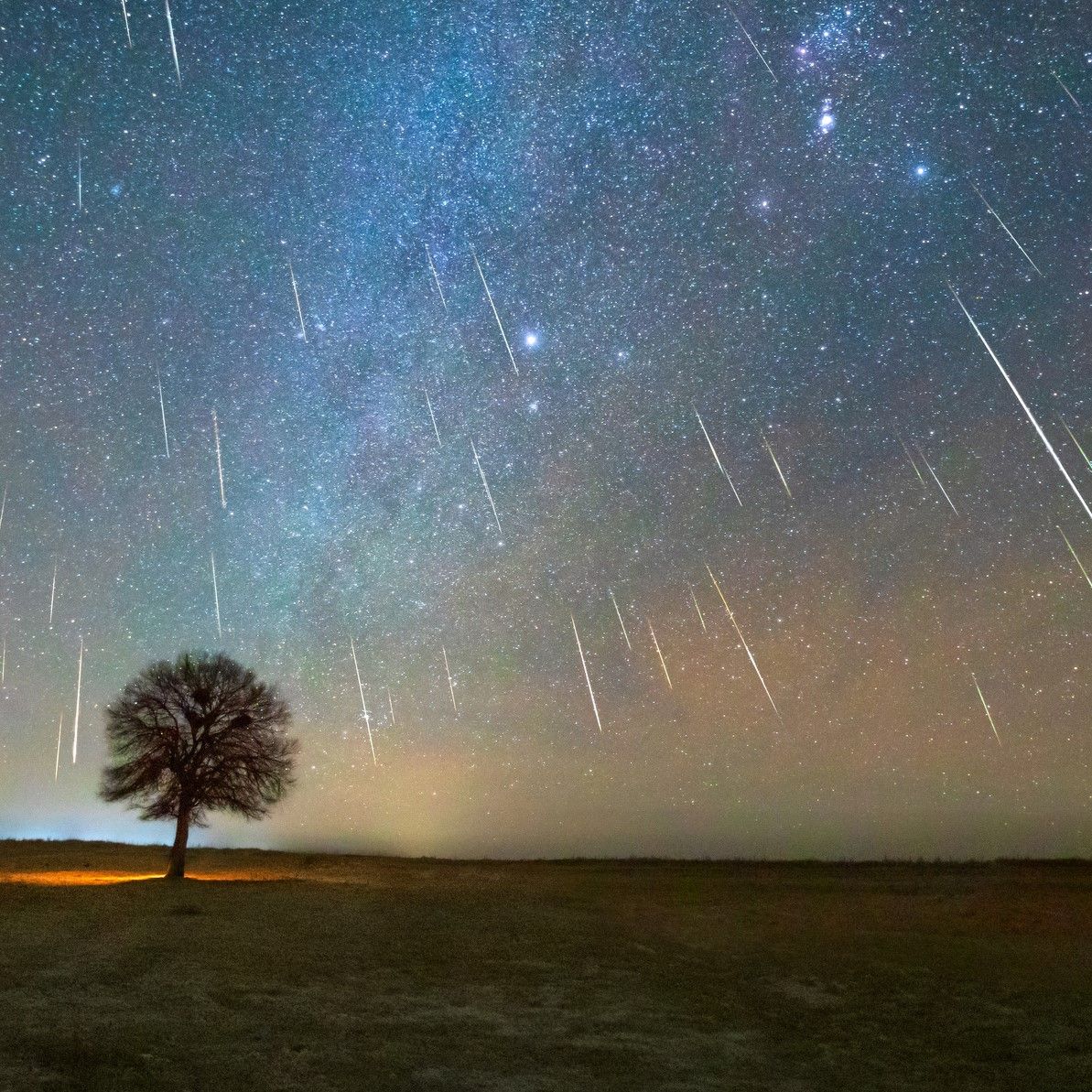
If you’ve been waiting for a “shooting star” spectacle, tonight is it. The Geminid meteor shower, widely regarded as the strongest and most reliable meteor shower of the year, reaches its peak between tonight and early tomorrow morning, with skywatchers potentially seeing up to 100–150 meteors per hour under dark skies.
What’s Happening In The Sky Tonight
The Geminids are an annual meteor shower that flares up each December as Earth plows through a stream of debris left by the strange rocky object
3200 Phaethon, often described as an “asteroid-comet hybrid.”
-
Peak timing: Night of
Dec. 13 into the early hours of Dec. 14 (local time).
-
Activity window: Roughly early evening tonight through dawn tomorrow, with rates climbing steeply after late evening.
-
Expected rate: Around
120–150 meteors per hour at very dark sites, according to meteor organizations and NASA estimates.
-
Moon factor: The Moon is about
30% full, so its light will interfere somewhat, but not enough to spoil the show for most observers.
According to the
American Meteor Society, the Geminids are “usually the strongest meteor shower of the year,” with a
Zenithal Hourly Rate (ZHR) around
150, meaning a group of observers under perfect dark skies could see on that order of meteors when the radiant is high overhead.
Where And When To Look
You don’t need a telescope or binoculars—just your eyes, patience, and a reasonably dark sky.
Best time:- Start watching from around
9–10 p.m. local time, when activity becomes obvious.
-
Peak viewing is typically
after midnight through about 2–3 a.m., as the shower’s radiant climbs higher in the sky and Earth turns more directly into the meteor stream.
Where to look:- The Geminids appear to
radiate from the constellation Gemini, near the bright star
Castor.
- In practice, the meteors will streak
all across the sky, so experts recommend:
- Face generally
away from bright city lights.
- Look
40–60° above the horizon rather than directly at the radiant for longer, more dramatic trails.
If you’re not sure where Gemini is, don’t stress—just give your eyes time to adjust and watch a wide patch of sky. You’ll still catch plenty of meteors as they fan out in all directions.
What You’ll Actually See
Geminid meteors are famous for being
bright, frequent, and colorful:
- Many appear
golden yellow or show hints of
green, red, or blue, thanks to different minerals burning up in Earth’s atmosphere.
- The
velocity is moderate—about
35 km/s (22 miles per second)—slower than some other famous showers like the Perseids, which can make the streaks feel more deliberate and easier to catch.
- Expect a mix of:
-
Bright fireballs that briefly light up the sky
-
Short, quick streaks popping off in all directions
Under good conditions, skywatchers across much of the
Northern Hemisphere can enjoy the best show, while those in the
Southern Hemisphere will still see Geminids but at lower rates because Gemini rides lower in their sky.
How To Get The Best View Tonight
If you want to turn tonight into a front-row seat to the cosmos, a bit of planning pays off.
1. Find darker skies if you canLight pollution is the biggest meteor-killer. If possible, head away from bright city centers to a park, open field, or rural area with a clear view of the sky.
2. Let your eyes adjustIt takes
20–30 minutes for your eyes to fully adapt to darkness. Avoid looking at your phone (or use red-night mode) while you’re observing so you don’t reset your night vision.
3. Get comfortable and stay warm- Bring a
reclining chair, blanket, or sleeping bag so you can lie back and take in as much sky as possible.
- Dress in
layers, especially if you’re out after midnight—many promising meteor sessions get cut short by cold toes.
4. Be patientMeteors tend to come in
clumps—you might see nothing for a couple of minutes, then several in quick succession. Give the sky at least
an hour to really appreciate the show.
Why The Geminids Are So Special
Most meteor showers come from comets, but the Geminids are different. Their parent body,
3200 Phaethon, behaves like a rocky asteroid but also dusts the inner Solar System like a comet when it swings close to the Sun.
Over time, that debris has spread into a dense stream along Phaethon’s orbit. Each year in mid-December,
Earth barrels through this rubble, and tiny grains—often no bigger than sand—hit our atmosphere and burn up as meteors.
Astronomy outlets like
Sky & Telescope note that the geometry of the Geminid stream, plus the high density of particles, is what makes this shower
consistently rich year after year, even outshining the better-known Perseids in August for many observers.
What Comes After Tonight
If clouds ruin your view or you just want more sky action, the Geminids aren’t your only December show:
-
Geminids duration: The shower is
active roughly from early to mid-December, with decent activity for a few nights around the peak.
-
Ursids (next up): Active
Dec. 17–26, peaking
Dec. 21–22, usually a much weaker but still interesting shower for northern observers, especially this year with a very thin Moon.
-
Quadrantids: Active from
Dec. 28 to Jan. 12, peaking
Jan. 2–3, known for a strong but very brief peak—though this season, a
full Moon will significantly hinder viewing.
So even if tonight is the main event, the sky has a follow-up program lined up for dedicated night owls.
Why This Meteor Shower Resonates With So Many People
The Geminids hit a sweet spot: they’re
predictable, spectacular, and accessible. No fancy gear, no paid tickets—just you, the night, and a bit of cosmic dust slamming into the atmosphere at tens of kilometers per second.
For many people, this becomes a kind of yearly ritual:
- Families bundling kids into the car and driving out to darker skies
- Friends turning meteor-watching into a low-key winter hangout
- Amateur astronomers logging counts and comparing activity year-to-year
From a journalist’s perspective, what makes nights like this special is that they quietly reconnect people with something bigger than their daily scroll: you step outside, look up, and remember that our planet is literally orbiting through a river of ancient debris.
If your forecast includes at least
patchy clear skies, tonight is worth the lost sleep.
Sources
1. The Geminid meteor shower 2025: How to watch
2. Meteor Shower Calendar 2025-2026
3. How and When to Best See the Geminids Meteor Shower
4. Geminid Meteor Shower 2025: Viewing Guide - YouTube
5. Geminid Meteor Shower Peaks December 13-14 - Sky & Telescope
6. Here's best time to see Geminid meteor shower this weekend, Dec. 13-14